About the Research Network • Since 2001
Termini Hungarian Language Research Network
The Termini Hungarian Language Research Network was established as a professional collaboration among Hungarian language research centres operating in regions outside Hungary within the Carpathian Basin. Its immediate background dates back to the 1990s, when professional contacts, conferences, joint research projects, and publications once again became regular forms of cooperation between linguists in Hungary and Hungarian linguists in neighbouring countries.
Origins and Institutionalisation of the Network
From the academic partnerships of the 1990s to a multi-country Carpathian Basin linguistic network
1990s • Academic Background
Living Language Conferences and Comparative Research
The immediate background to the formation of the network dates back to the 1990s, when professional contacts, conferences, joint research projects, and publications once again became regular forms of cooperation between linguists in Hungary and Hungarian linguists in neighbouring countries.
The Living Language Conferences played an important role in this process, as did comparative research projects covering the Carpathian Basin that focused on describing varieties of Hungarian spoken outside Hungary, exploring their social context, and documenting their distinctive patterns of language use.
2001 • Established with Support from HAS
The Founding Research Centres
The institutions of the research network were established in 2001 at the initiative and with the support of the Hungarian Academy of Sciences in several regions of the Carpathian Basin outside Hungary. The first research centres included the Attila Szabó T. Language Institute in Transylvania, the Gramma Language Office in Southern Slovakia, the Antal Hodinka Research Centre for Linguistics in Transcarpathia, and the Magyarkanizsa Sociographic and Sociolinguistic Workshop in what was then Serbia and Montenegro.
2003–2014 • Smaller Regions & Institutionalisation
Becoming a Carpathian Basin-Wide Network
At a workshop held in Ilieni, Transylvania, in 2003, an agreement was reached to involve individual research sites in the smaller regions of Austria, Croatia, and Slovenia in the network’s joint research activities. In subsequent years, these individual research sites became institutionalised: the Samu Imre Language Institute was established in 2007, followed by the Verbi Language Research Workshop in Vojvodina in 2013 and the Glotta Language Institute in Croatia in 2014. Termini thus gradually developed into a Carpathian Basin-wide network of Hungarian linguistic research centres spanning several countries.
Scholarly Approach and Operational Model
Exploring, documenting, and comparing varieties of Hungarian spoken throughout the Carpathian Basin
Perspective
Unity in Diversity
At the heart of Termini’s work is the study of the varieties of Hungarian spoken throughout the Carpathian Basin. From the network’s perspective, the unity of the Hungarian language does not imply uniformity; rather, it involves the scholarly exploration, description, and recognition of regional varieties as linguistic values in their own right. Termini researchers therefore approach Hungarian language use in regions outside Hungary not as a peripheral phenomenon, but as an integral part of the Hungarian language as a whole.
Joint Programme
Linguistic Debordering
One of the network’s best-known joint programmes is linguistic debordering, which aims to document distinctive features of Hungarian varieties outside Hungary, provide scholarly descriptions of differences between language use in Hungary and in Hungarian communities beyond its borders, and incorporate the resulting findings into reference works, dictionaries, and databases.
Organisation
Regional and Shared Research
An important feature of the network is that it combines regionally based research centres with joint Carpathian Basin-wide programmes. Individual institutions examine the linguistic situation of their own countries and regions while also participating, within the framework of Termini, in shared theoretical, methodological, and database-building activities, enabling local features to be presented in a comparable way and developing a more integrated scholarly understanding.
Research Fields and Flagship Programmes
Comprehensive sociolinguistic, lexicographic, terminological, and language policy research
Disciplinary Scope
Core Fields of the Research Network
The research network covers a wide range of fields. These include bilingualism and language contact, the description of Hungarian varieties outside Hungary, language policy and linguistic rights, language planning, terminology, lexicography, onomastics, the linguistic dimensions of education, linguistic landscape research, and the linguistic, social, and institutional situation of regional Hungarian communities.
Particular emphasis is placed on research examining the practical use of Hungarian, the implementation of minority language rights, the conditions of mother-tongue education, and everyday linguistic practices in multilingual social environments.
Lexicography • Since 2004
Termini Online Hungarian Dictionary
One of Termini’s most significant joint achievements is the creation and continuous development of the Termini Online Hungarian Dictionary. The list of Hungarian words used outside Hungary, launched in 2004, has since developed into an online dictionary. It collects, systematises, and makes searchable distinctive lexical items found in varieties of Hungarian spoken in countries neighbouring Hungary. This lexicographic work serves several purposes at once: scholarly documentation, communication among Hungarian-speaking communities, the strengthening of linguistic awareness, and the greater visibility of regional linguistic values.
Specialised Terminology & Databases
Terminology Research
In recent years, terminology research has assumed an increasingly important role in Termini’s activities. The network’s research centres participate in the study of legal, administrative, and educational terminology, as well as in the development of a Carpathian Basin database of educational terminology. This work seeks to systematically record not only educational and specialised terms used in Hungary, but also their equivalents in the official languages of neighbouring countries. Such research is particularly important for Hungarian minority education, translation, official language use, and specialised language planning.
Visual & Public Spheres
Linguistic Landscape Research
Termini’s research programmes also extend to the visual and public dimensions of language use. Linguistic landscape research examines the presence of languages in public spaces, institutions, schools, public offices, memorial sites, businesses, religious and civic spaces, as well as on online platforms. These studies explore how Hungarian and other languages appear in the everyday life of multilingual regions and investigate the relationships between linguistic rights, local government decisions, community presence, and linguistic visibility.
Anniversary Milestones and Scholarly Reviews
Conferences and landmark volumes marking a quarter century of Termini
2011 • 10th Anniversary
Leghia and Budapest (HAS)
To mark the network’s 10th anniversary, a meeting was held in Leghia in June 2011, followed by a jubilee conference at the headquarters of the Hungarian Academy of Sciences in Budapest in November. The volume Ten Years of the Termini Hungarian Language Research Network was presented on this occasion.
21–22 October 2016 • 15th Anniversary
International Conference in Osijek
The 15th anniversary was marked in Osijek on 21–22 October 2016 by the international academic conference Possibilities for Preserving the Mother Tongue on the Periphery of the Hungarian Language Area – 15 Years of Termini, where the network’s institutions presented both regional and joint research topics.
18 November 2021 • 20th Anniversary
Two Decades of Practice – HAS
The 20th anniversary was celebrated at the Hungarian Academy of Sciences on 18 November 2021. At the conference Research and Planning in Two Decades of Practice of the Hungarian Language Research Network Beyond Hungary (Termini), representatives of the individual research stations presented the current linguistic situation in their respective regions and related research findings.
4 June 2026 • 25th Anniversary
25 Years of Research, Planning and Service
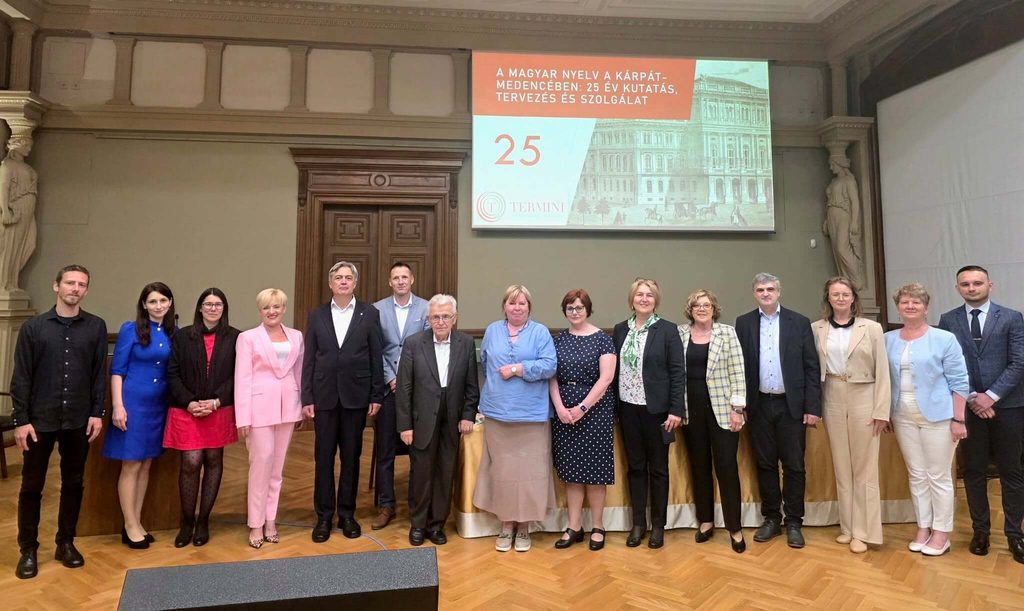
To mark the 25th anniversary, the selected volume The Hungarian Language in the Carpathian Basin: 25 Years of Research, Planning and Service was published in 2026, providing an overview of twenty-five years of scholarly work by the network. On 4 June 2026, an international conference under the same title was also held at the Hungarian Academy of Sciences.
Twenty-Five Years in Review
Research Network, Scholarly Workshop, and Professional Community
Over the past twenty-five years, the Termini Hungarian Language Research Network has developed into one of the major forms of professional collaboration in Hungarian language research across the Carpathian Basin. Its work has contributed to the scholarly description of Hungarian varieties outside Hungary, greater recognition of the regional diversity of Hungarian, the investigation of the legal and social dimensions of minority language use, and the creation of shared databases and research programmes that enrich the study of the Hungarian language as a whole.
Termini is at once a research network, a scholarly workshop, and a professional community devoted to studying the presence, diversity, and practical use of Hungarian throughout the Carpathian Basin.